Corporate healthy-living seminar: an evidence guide
What should a corporate healthy-living seminar cover, how long should it run, and what should you measure after? An evidence-led guide for HR and L&D.
A healthy-living seminar is a measurable training session that gives employees current, research-based guidance on movement, sleep, nutrition and energy management, along with a practical framework. A well-built seminar works differently from a motivational talk: it leaves behind a concrete behavior step and a measurement baseline, not just applause. This post lays out what HR and L&D teams should look for when choosing a corporate healthy-living seminar.
What's the difference between a healthy-living seminar and a motivational talk?
Both use a stage, a microphone and a speaker; the goals differ. A motivational talk aims for an emotional moment: a story, an anecdote, a call to "take action." An evidence-based healthy-living seminar rests on a defined content framework, a measurable objective and, ideally, a before/after comparison.
A 2025 systematic review examined 40 randomized controlled trials published between 2013 and 2023 and found that half of workplace health interventions used multimodal designs combining education, physical activity and nutrition, and that these multimodal designs produced stronger results than single-component interventions (Zhang, Nie, Peng and Ren, Healthcare, 2025). In short: a good seminar isn't a standalone "event," it's the entry point of a broader program.
What topics should a healthy-living seminar cover?
Five recurring, complementary topics show up across the field:
- Ways to build movement into daily life. Equipment-free, sustainable movement habits that fit an ordinary workday.
- Concrete answers to "how do I become more active?" Not generic advice, but options adaptable to an employee's actual day.
- The relationship between movement and health. The World Health Organization recommends 150-300 minutes of moderate-intensity (or 75-150 minutes of vigorous-intensity) physical activity per week for adults (WHO, Physical Activity); a good seminar explains where that threshold comes from.
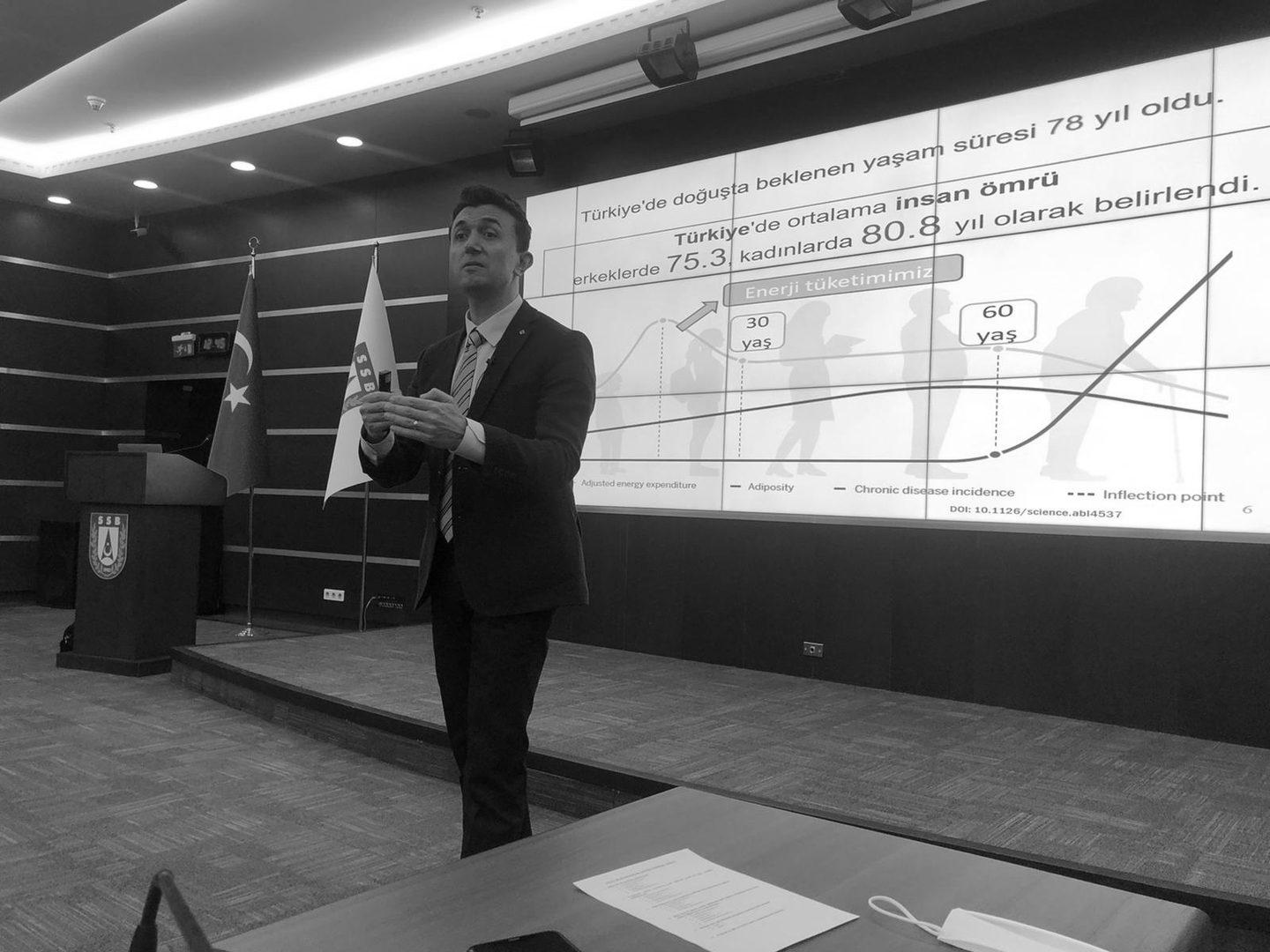
- Exercise, energy expenditure and metabolism across the lifespan. This is where a good seminar corrects popular myths: a large analysis using doubly-labeled-water data found that daily energy expenditure, adjusted for fat-free mass, stays remarkably stable between ages 20 and 60, with the real decline starting only after 60 (Pontzer, Yamada, Sagayama et al., Science, 2021). That should replace clichés like "your metabolism slows down in your thirties."
- How genetics and environment shape body composition. Making clear that weight and body composition aren't purely a matter of willpower, but an interaction between genetic predisposition and environment (work pace, sitting time, sleep).
These five topics match the content of the seminar Prof. Dr. Murat Erdoğan delivered for the Presidency of Defence Industries (SSB) "Bilgi Arası Programı" on 13 April 2022 at the Nuri Demirağ Conference Hall, titled "Healthy Living and Exercise Strategies," and its 90-minute online repeat on 17 May 2024.
How large a group, and how long should it run?
There's no single "ideal duration" in the literature, but two observations give a practical frame. First, most programs reviewed in the 2025 review above run on a 12- or 24-week cycle, with a single seminar serving as the entry point. Second, in ME's own practice a 90-minute online format is enough to cover the five topics above while leaving room for Q&A.
Group size matters for interaction: a group of 30-80 can ask questions, while a 500-person "all-hands" turns into passive viewing. In larger companies, the practical answer is to repeat the same content in smaller, department-level sessions.
Does a single seminar change behavior?
Honestly: on its own, only to a limited extent. A recurring finding in health-behavior-change research is that single-component interventions have limited effect, while multicomponent approaches (education plus practice plus follow-up) deliver more consistent results. A large systematic review and meta-analysis of workplace nutrition and physical activity programs found that multicomponent programs produced measurable improvements in fruit-and-vegetable intake and body-composition markers, though the size of the effect depended on the program's scope and duration (Peñalvo et al., Lancet Public Health, 2021).
The practical takeaway: a seminar is not the outcome itself, it's the first measurement point of a program. Without the same short survey before the seminar and again a few months later, you can't answer "did it work."
How do you tell a real seminar from a motivational talk?
A short checklist for HR:
- Sourcing: Is the content based on peer-reviewed research or on anecdote? Can the speaker cite sources?
- Track record: Does the speaker have a verifiable background in exercise science, sport physiology, or a related field?
- Adaptation: Can the content be adapted to the company's own data (sitting time, absenteeism, survey results), or is it the same slide deck for everyone?
- Measurement plan: Is there a proposed before/after measurement?
- Output: Does the talk end with 2-3 concrete, actionable steps, or a generic "take action" call?
If you answer "no" to three or more of these, what you have is likely a motivational talk, not a healthy-living seminar.
ME's approach
Prof. Dr. Murat Erdoğan has applied this content framework in corporate settings multiple times: the SSB "Bilgi Arası Programı" (2022), its online repeat (2024), and the "Get Moving" ("Harekete Geç") session for Başkent University's Faculty of Health Sciences "R&D and Academic Vision Seminars" (2024). With the same discipline, we can design a seminar adapted to your company's own data, followed by a measurable program; our corporate wellness programs use these seminars as a starting point. You can see everything we've done so far on the our work page.
How is a seminar adapted to a company's own data?
The same five topics carry different weight across employee groups. For field teams, "building movement into daily life" isn't about adding more activity, it needs to be reframed around recovery and sleep; for office teams, breaking up sitting time takes priority. A good provider looks at the company's absenteeism, employee survey, or wearable data (where available) before the talk and weights the content accordingly. A provider that presents the same generic slide deck to every company likely isn't adapting the content at all.
Three common mistakes
- Presenting only to managers. The seminar happens once, in a leadership meeting, and never reaches the broader workforce, so the effect stays there too.
- No follow-up. When no measurement or reminder follows the seminar, most of what was learned is forgotten within a few weeks.
- Never touching the company's own data. When content stays entirely generic, employees sense "this is being told to everyone, not to us," and participation and follow-through drop.
Frequently asked questions
How long should a healthy-living seminar run?
There's no fixed rule, but 60-90 minutes (including Q&A) is a practical range to cover the five core topics without skimming. Repeating the same content with smaller groups tends to work better than a single half-day, all-company event.
Is online or in-person more effective?
Both can work with the same content framework; ME's 2022 in-person SSB seminar and its 90-minute online repeat in 2024 covered the same five topics. The choice should depend on the group's geographic spread and interaction needs; what matters more than the format is the measurement plan.
What should be tracked after the seminar?
A simple before/after survey (e.g. perceived energy, movement frequency, sleep quality), supported by simple functional tests, is a reasonable starting follow-up. Individual data is never shared; the employer only sees anonymized, aggregated trends.
Up to how many employees can one session cover?
30-80 people is a practical upper limit for an interactive session. In larger companies, repeating the same seminar across department-level groups keeps the interaction while still reaching everyone.
You can't know whether a seminar actually worked without measuring it; if you're curious about the weight and body-composition side, see our post on weight management for employees, and on burnout data, see employee burnout in Türkiye.