Weight management for employees: an evidence guide
How should weight management be handled at work? Energy balance, exercise vs diet, sitting time and sleep, in an evidence-led framework with no diet plans.
Weight management is not a single diet or a single exercise program; it's an ongoing process that treats energy balance, movement, sitting time and sleep together. A weight-management approach that actually works in a corporate setting doesn't hand out meal plans; it measures, spreads movement through the day, and reports the result in numbers. This post lays out an evidence-based framework for HR and wellbeing teams.
Why is weight management a corporate topic in Türkiye?
The numbers move this from a personal choice to a workforce health issue. According to TÜİK's 2022 Türkiye Health Survey, the obesity rate among adults 15 and older fell from 21.1% in 2019 to 20.2% in 2022; the rate was 23.6% among women and 16.8% among men (Anadolu Agency, reporting TÜİK data). In other words, in an average Turkish office roughly one in five employees is at or above the obesity threshold, and a day spent sitting doesn't change that picture, it more likely reinforces it.
What does energy balance mean for weight management?
Change in body weight is, at root, explained by the gap between energy intake and energy expenditure. But in a corporate program that simple equation becomes two practical questions: how much of an employee's day is movement versus sitting, and what's actually driving the imbalance, diet, inactivity, or a lack of recovery? An evidence-based program addresses all three together, not one at a time.
Exercise or diet: which one actually removes weight?
The honest answer: both are limited alone, and more effective together. A systematic review and meta-analysis of direct comparisons found that exercise-only programs produced 5.33 kg less weight loss at 3-6 months and 6.29 kg less at 12-18 months than combined diet-and-exercise programs; diet-only programs matched combined programs in the short term, but combined programs produced 1.72 kg more weight loss at 12 months (Johns, Hartmann-Boyce, Jebb and Aveyard, Journal of the Academy of Nutrition and Dietetics, 2014).
This doesn't mean exercise is "weak" for weight management, it means its role is different: exercise alone isn't as powerful as diet for losing weight, but it's irreplaceable for weight maintenance, preserving muscle mass, and health gains that are independent of weight (cardiovascular, metabolic, cognitive). A corporate program should position exercise as sustainable health infrastructure, not a weight-loss tool.
How do sitting time and sleep affect weight management?
Two factors are often overlooked, but show up clearly in the data:
- Sitting time. A large meta-analysis covering more than a million people found that about 60-75 minutes of moderate-intensity physical activity per day can eliminate the increased mortality risk associated with prolonged sitting (Ekelund et al., The Lancet, 2016). Reaching that threshold on its own is hard in a desk job, which is why movement breaks are part of weight management, not a separate topic.
- Sleep. A meta-analysis of 30 studies covering 634,511 people found that each 1-hour reduction in sleep in adults was associated with an average 0.35-unit increase in BMI, and short sleep duration was significantly associated with obesity (Cappuccio et al., Sleep, 2008). Sleep is too central a variable to leave out of the weight-management conversation.
Do corporate weight-management programs actually work?
A qualified yes. A large systematic review and meta-analysis of workplace nutrition and physical activity programs found that multicomponent programs were associated with an average 1.3 kg weight loss (95% CI 0.5-2.1) and a 0.5-unit drop in BMI (95% CI 0.2-0.8) (Peñalvo et al., Lancet Public Health, 2021). The numbers are modest and evidence quality varies across studies; but the effect is real and in the right direction. Expecting a corporate program to get "everyone to their ideal weight" isn't realistic; expecting a "measurable, sustainable improvement" is.
How do you build an evidence-based corporate weight-management program?
A four-step framework that doesn't involve handing out meal plans:
- Baseline measurement. BMI, waist circumference, and a short voluntary survey (movement, sleep, sitting time). Individual results are shared only with the employee.
- Movement and recovery protocol. Movement breaks embedded in the workday, short interruptions to sitting time, sleep-hygiene guidance.
- Referral, not prescription. Dietary change is a personal matter; the corporate program doesn't prescribe diets, it refers to a dietitian or physician when needed.
- Re-measurement. Comparison against the same indicators after 6-12 months. A systematic review of 23 studies found that workplace weight-management interventions were most consistently effective in 6-12-month programs, regardless of region (Weerasekara, Roberts, Kahn et al., Current Obesity Reports, 2016).
This is not a diagnostic or treatment program. Diagnosing and treating obesity is a physician's domain; the corporate program only builds the movement, recovery and measurement infrastructure.
Should the approach differ across employee groups?
The same four steps should be weighted differently by employee profile. For office staff, the priority is breaking up sitting time and inserting short movement breaks into the day; for field teams or shift workers, the priority is usually recovery and sleep after an already-demanding physical load. For managers, the most common barrier isn't time but travel and irregular meal schedules, so the program should offer a flexible, travel-adaptable movement protocol for this group. A single "one-size-fits-all" design doesn't fully work for any of them.
Three common mistakes
- Using the scale as the only indicator. Weight alone can be misleading; waist circumference and fitness markers (e.g. a walking test) should be tracked alongside it.
- Turning the program into a competition. A "whoever loses the most wins" format draws short-term interest but can encourage fast, unsustainable methods, and it's no substitute for a measurement-focused program.
- Handing out meal plans. Nutrition is a personal, medical matter; the corporate program refers employees to professionals instead of prescribing diets.
ME's approach
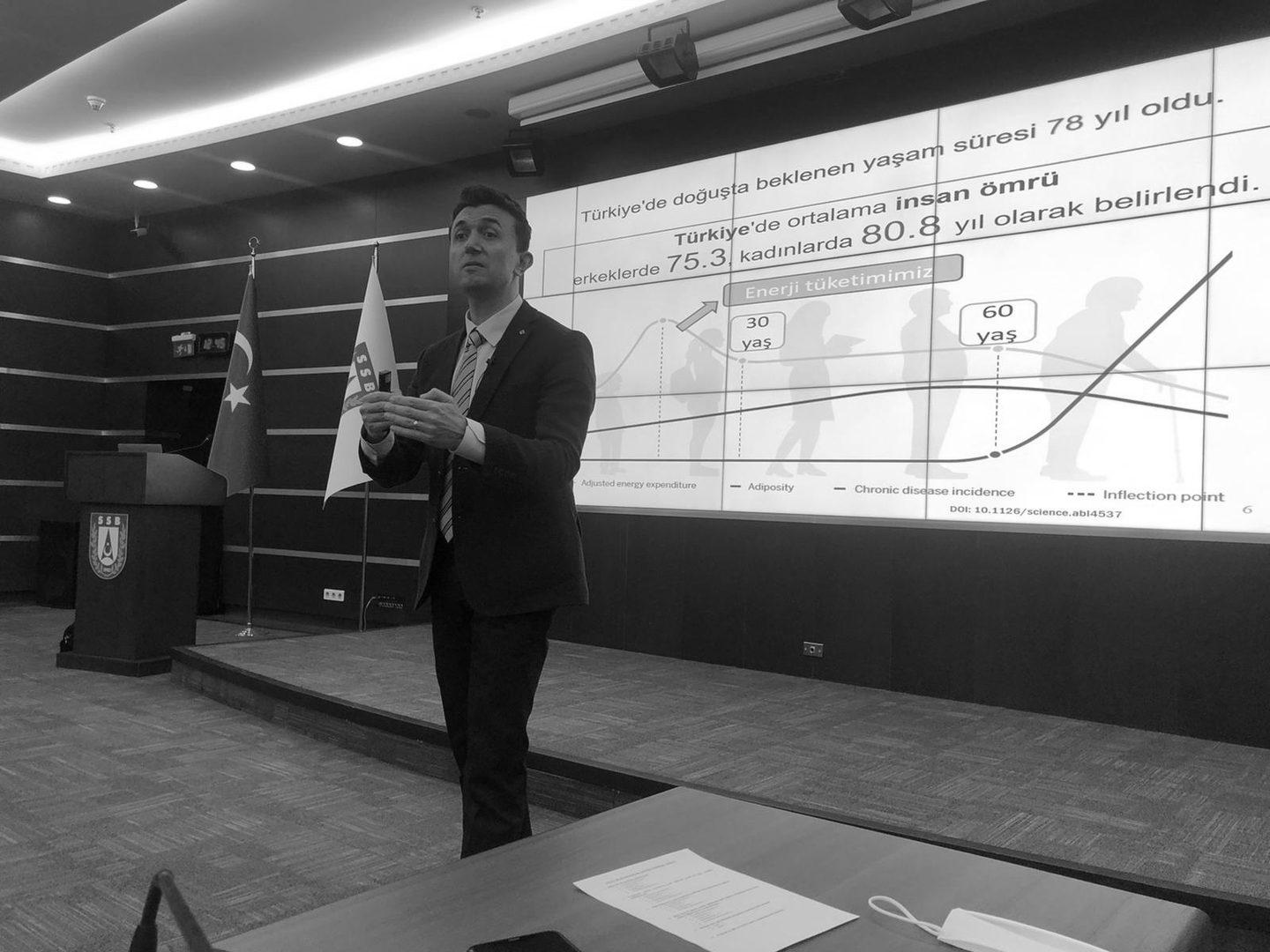
One of the topics in the "Healthy Living and Exercise Strategies" seminar Prof. Dr. Murat Erdoğan delivered for the SSB "Bilgi Arası Programı" (2022) and its online repeat (2024) was exactly how genetics and environment shape body composition; Ofis Egzersizleri El Kitabı (Office Exercise Handbook) covers equipment-free movement protocols for desk-based employees. With the same discipline, we can build a measurement and movement framework adapted to your company's data; we design this as part of our corporate wellness programs. See everything we've done so far on the our work page.
Frequently asked questions
How many months does a weight-management program take to show results?
Research on corporate programs finds effects most consistent at 6-12 months (Weerasekara et al., 2016). Shorter programs may show no visible result, and much longer ones tend to lose participation, so a 6-12-month cycle with regular check-ins is a reasonable starting point.
Is it possible to lose weight with exercise alone?
To a limited extent. Direct comparisons show exercise-only programs produce less weight loss than programs that include diet (Johns et al., 2014). Exercise's real strength is in weight maintenance, preserving muscle mass, and weight-independent health gains, which is why it should never be presented on its own as "the" weight-loss solution in a corporate program.
Is individual data shared with the employer in a corporate program?
No. Individual measurement results are shared only with the employee; the employer only sees anonymized, aggregated trends. That separation is a precondition for employees to trust and join the program.
Is weight management the same thing as weight loss?
No. Weight loss is a one-time target; weight management is an ongoing process that continuously tracks movement, sleep and energy balance. A corporate program aims at the latter, building sustainable movement and measurement infrastructure over the year rather than a short-term weight-loss contest.
If you're curious how to spread movement through the workday, see our office exercise guide; if you want to know what a good training session should cover, see our post on healthy-living seminars.